7 simple privacy habits for studying with AI

Whether you’re studying for a degree, developing professionally, or simply taking a course to keep your brain from turning to mush, chances are AI will be part of the process. Yes, letting AI serve up answers on a silver platter can undermine learning and critical thinking, especially since a confident-sounding answer can still be wrong. But used as a tutor, AI can genuinely help you learn, and refusing to use it altogether is already becoming a disadvantage.

But making AI work for you comes with a catch: once you share something with an AI service, you may not be able to fully take it back. A single study prompt, screenshot, or document can reveal your identity, private conversations, unpublished research, and sometimes other people’s sensitive data too. These seven habits will help you use AI without sharing more than you intended.

Jump to:
1. Files and screenshots · 2. Work and research data · 3. Group chats · 4. Personal essays · 5. Managed and shared devices · 6. AI data settings · 7. Sharing AI chats

1. Send the relevant excerpt, not the whole file or screen

The situation: You ask an AI assistant to review an assignment and upload the file with your name, email, class, and your tutor’s comments. For statistics homework, you send it the spreadsheet your group has been working in, complete with your classmates’ names, email addresses, and study year. Or you take a quick screenshot of something on your learning platform, forgetting that the browser window also shows your pinned tabs, open chats, account name, and notifications.

What are the risks: Once those details are uploaded, they are no longer sitting only on your device. They may be saved alongside the conversation and become part of AI training material. And if someone gets into your account or the AI service suffers a data breach, a quick request for study help could expose your personal information, your classmates’ details, or both. It is surprisingly easy to share too much. One university official wrote on Reddit that they had uploaded photos of sign-up sheets to Gemini, only to realize to their horror afterward that the images contained around 200 students’ email addresses. In Australia, a government employee uploaded a spreadsheet to ChatGPT containing names, contact details, addresses, dates of birth, sensitive health information, and financial commentary. The incident was classified as a data breach affecting over 2,000 people.

What to do: Give AI only what it needs, not everything you have. Paste the relevant passage and take a few seconds to check files and screenshots for names, email addresses, IDs, notifications, or anything else you did not mean to share.
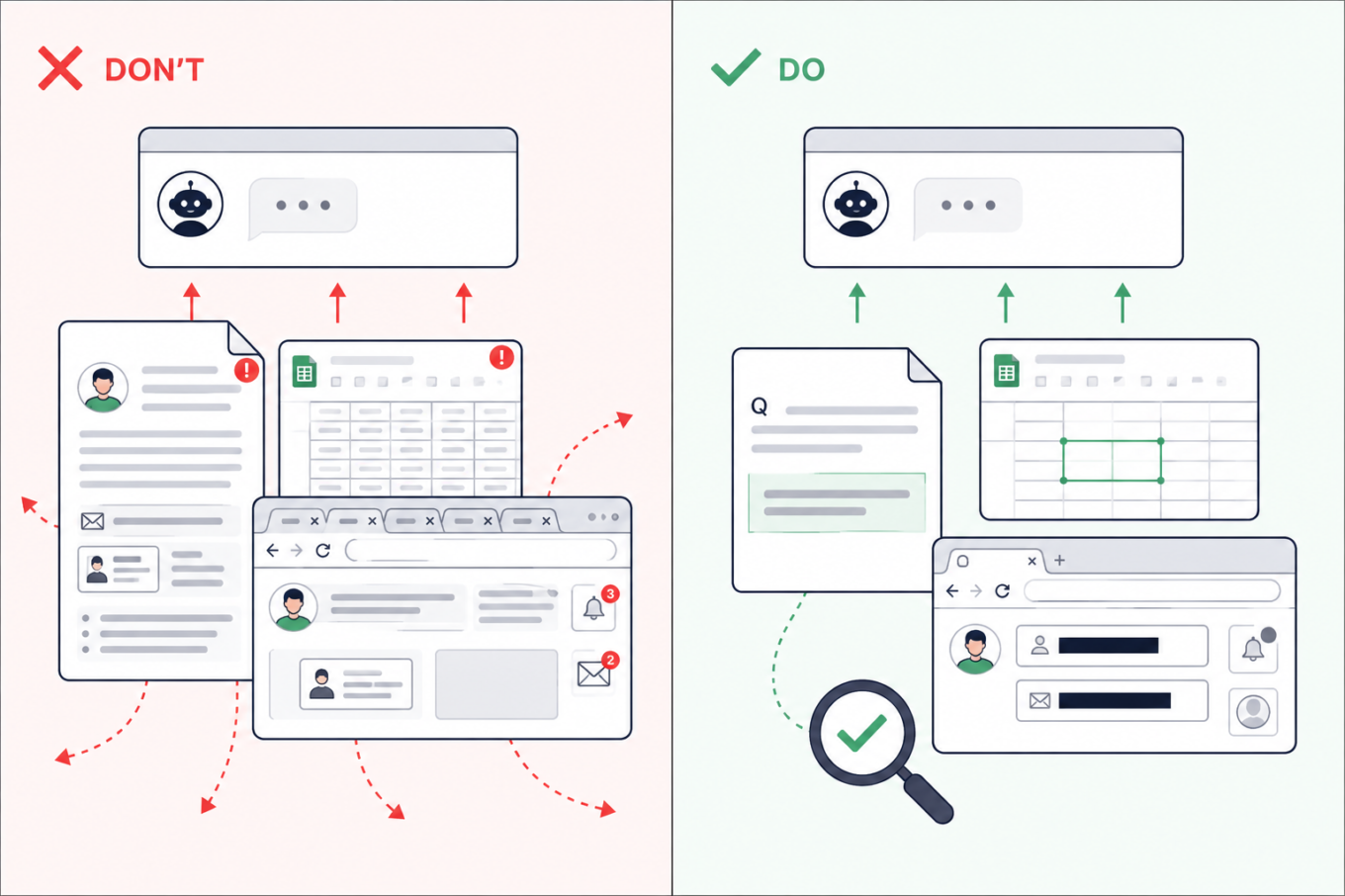
Don’t upload an entire assignment, spreadsheet, or browser screenshot to AI. Share only the relevant passage or cells after removing names, emails, tabs, and notifications

2. Check which AI tools are approved before using work or research data

The situation: Many of us juggle work and study, so material from one easily finds its way into the other. Sometimes that is not carelessness: real company data may be part of the learning process. While working on an assignment in your personal AI account, you might ask the AI assistant about code from work, upload a company spreadsheet for data-analysis practice, or request feedback on an unpublished dissertation chapter.

What are the risks: A personal AI account may not have the protections or defaults required by your employer or university. Uploading confidential material could break an NDA or internal policy — and if the account or service is compromised, that information could be exposed. This has already caught people out. Samsung restricted generative AI after employees reportedly shared confidential source code and meeting information with ChatGPT. A PhD student also claimed on Reddit that findings from uploaded dissertation chapters later appeared in answers generated for a friend.

What to do: Use an AI service approved by your employer or university and remove details the tool does not need. If there is no approved service, keep company files, client information, unpublished findings, and anything covered by an NDA out of AI. You can still describe the problem in general terms without pasting the confidential material itself.
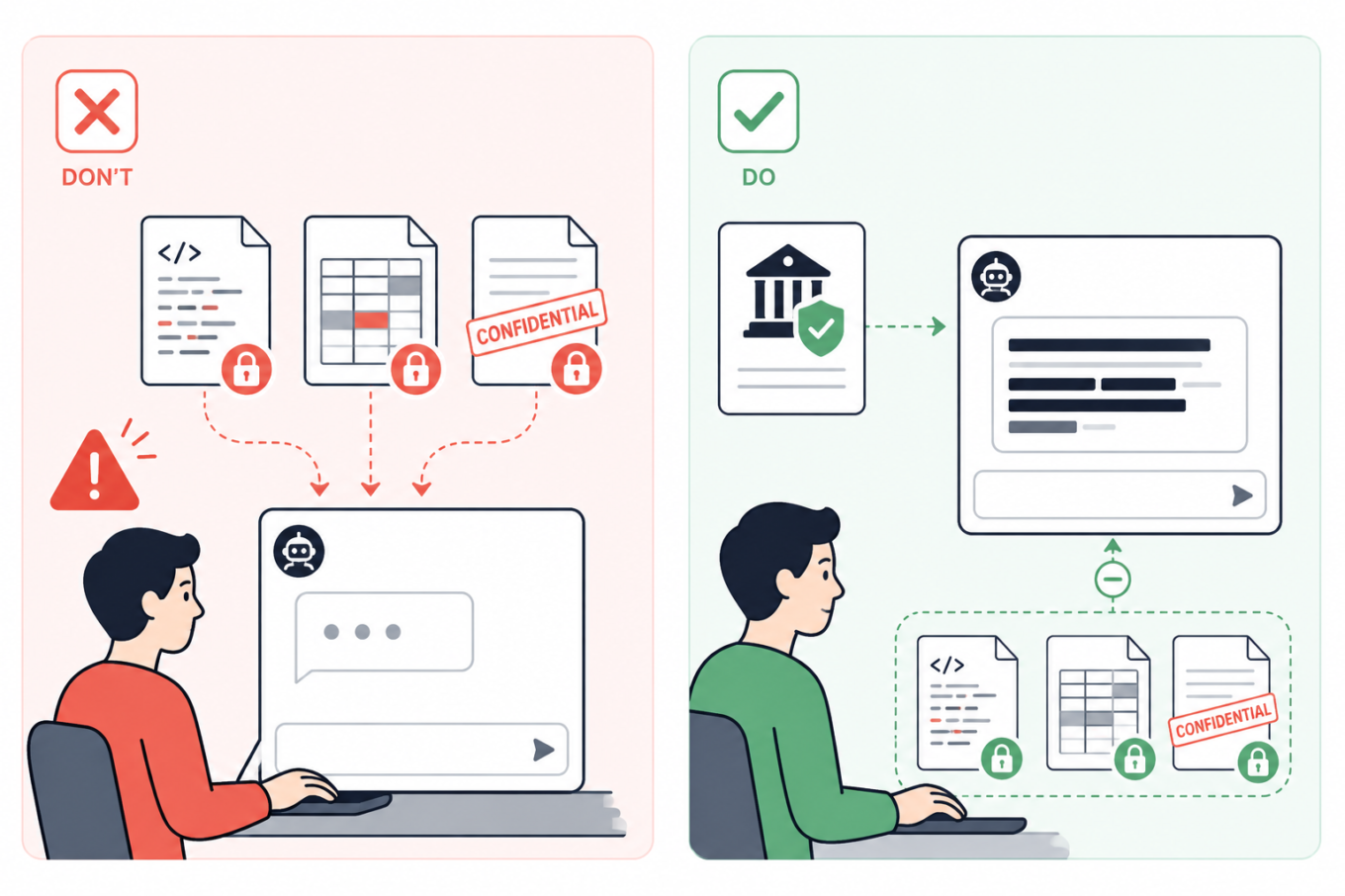
Don’t send confidential code, company data, or unpublished documents to a personal AI account. Use an institution-approved tool and keep protected files out of the chat

3. Summarize group chats yourself — or remove every name first

The situation: Your class or project chat has hundreds of messages, so you ask AI to summarize the decisions, deadlines, and tasks. But the screenshots or exported chat may also bring along people’s names, phone numbers, profile photos, personal comments, and arguments that have nothing to do with the assignment.

What are the risks: A group chat can reveal much more than expected: who people are, how to contact them, and what they discuss. Once sent to an AI service, those details may be stored with the conversation. If your account or the service is compromised, they could be exposed and help scammers create much more convincing phishing messages.

What to do: If possible, write a quick summary yourself and ask AI to turn it into a task list, meeting notes, or a study plan. That way, the assistant gets the information it needs without seeing the original conversation. If you do need to paste messages, remove names, usernames, phone numbers, profile photos, and other identifying details. Where the speakers matter, replace their names with labels such as Student A and Student B.
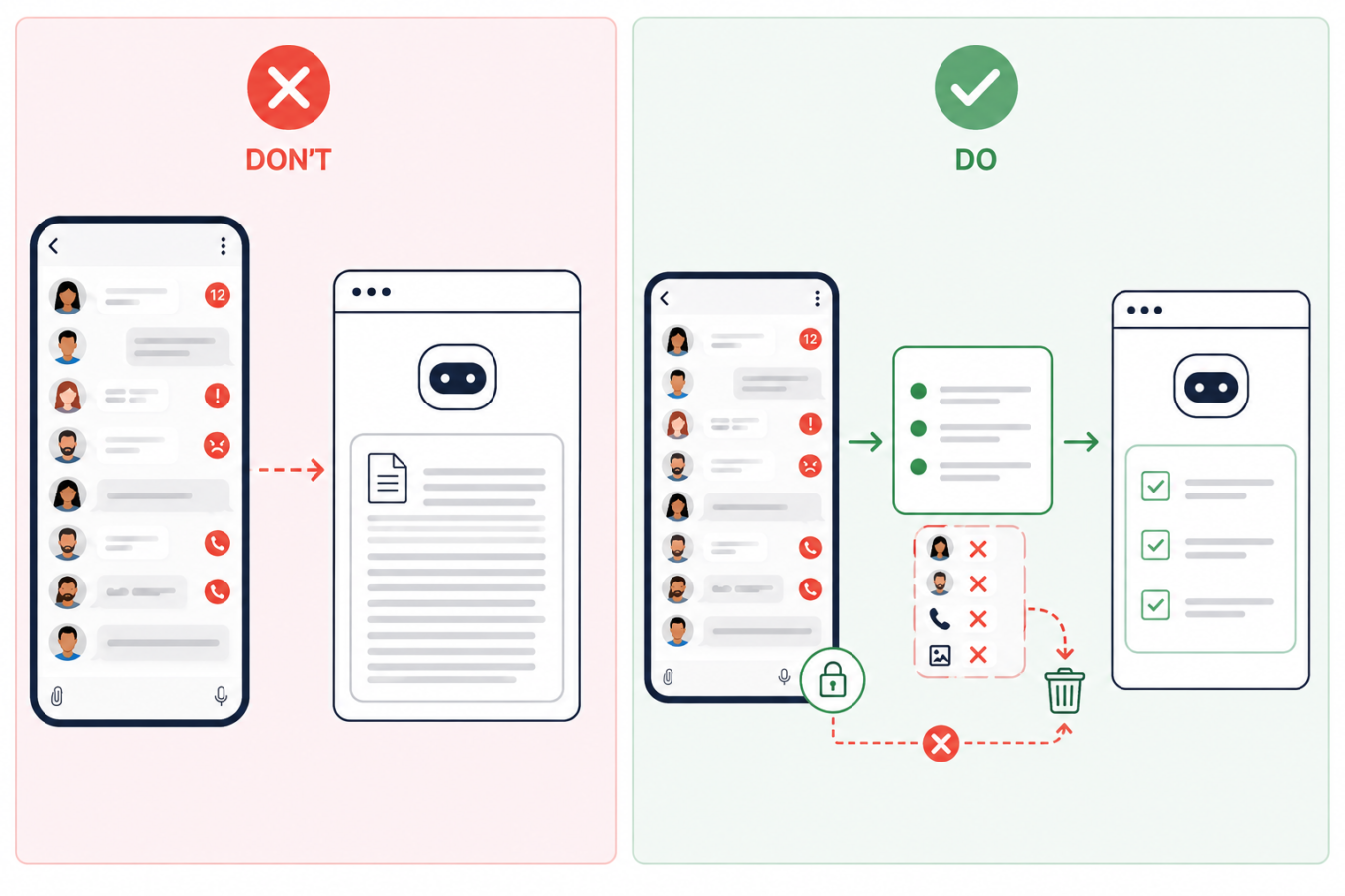
Don’t upload an entire group chat to AI. Summarize the relevant messages first and remove names, phone numbers, profile photos, and other identifying details

4. Remove identifying details from personal essays

The situation: You ask AI to edit a course application, scholarship form, résumé, cover letter, or a piece about your personal experience. Because more context often produces a better answer, it may be tempting to share a lot about your work, location, finances, health, or family.

What are the risks: A prompt does not need to contain your name to identify you. A distinctive combination of places, dates, institutions, and life events may be enough — and once the conversation has been stored, shared, or exposed, those details are difficult to take back.

What to do: Keep the context AI genuinely needs, but remove names, contact details, student numbers, exact dates and locations, and unnecessary references to a specific school or employer. A good rule of thumb is to write sensitive prompts as though the conversation could eventually become public.
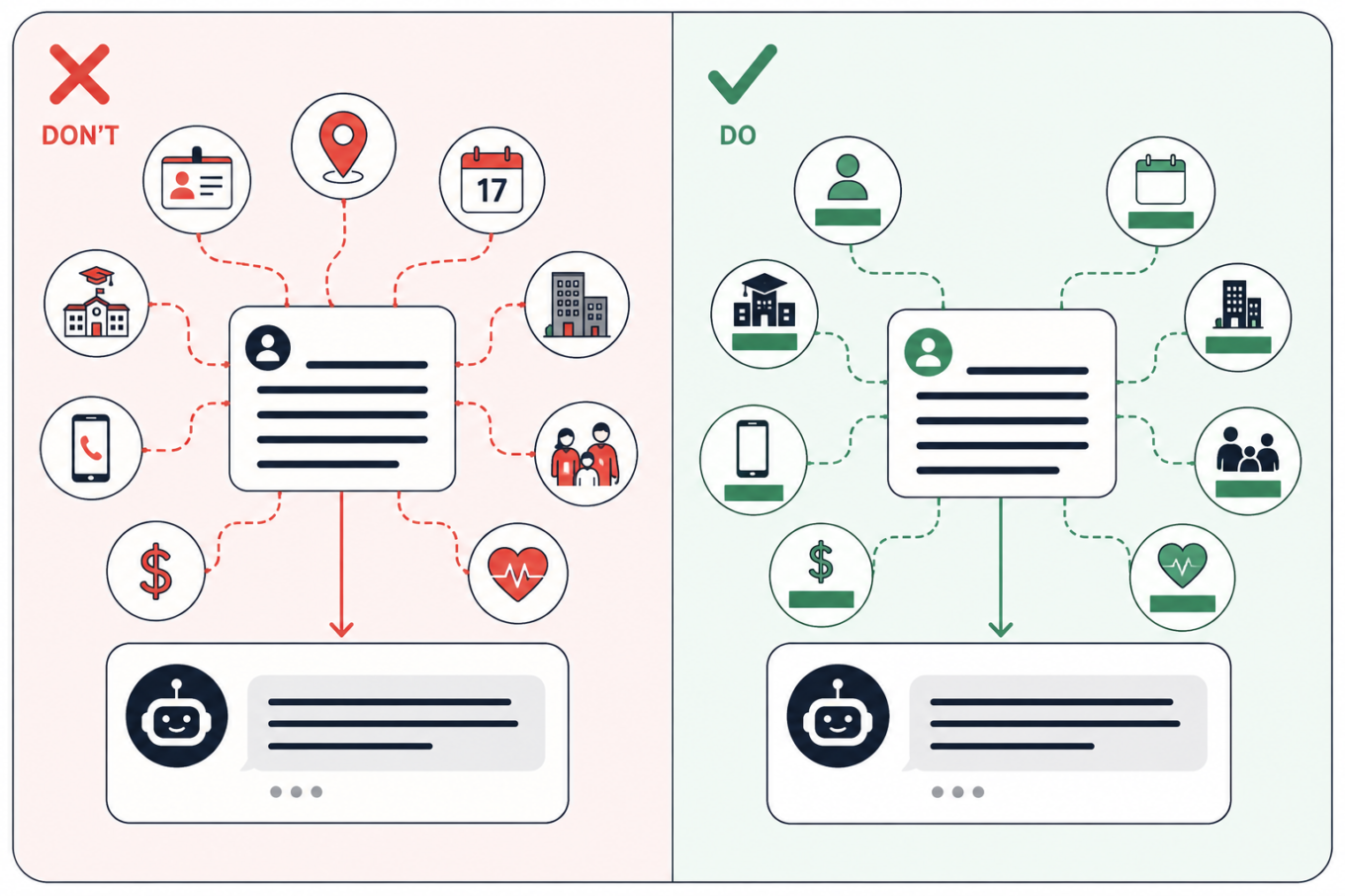
Keep the context AI needs from a personal essay, but remove details that could identify you, such as your school, employer, location, exact dates, contacts, finances, or family information

5. Keep personal searches off managed and shared devices

The situation: You open an AI assistant on a school or work laptop, or on a shared computer in a library. You start with a study question, but because the conversation feels private, you gradually drift into personal topics.

What are the risks: The device or account other than your own or created by you may be monitored — and if you forget to log out of a shared computer, someone else could read your chats. Monitoring tools can scan messages, documents, and searches for signs of violence, self-harm, or other concerning behavior. They do not always understand context. In one case reported by the Associated Press, software flagged a joke written by a 13-year-old in a monitored school chat. She was arrested, interrogated, strip-searched, spent a night in jail, and was later placed under house arrest. That case is extreme, but the same privacy risk applies to shared computers in libraries, coworking spaces, and other public places too.

What to do: Assume that activity on a managed device or account may be visible to the institution. Keep personal conversations, private writing, and sensitive searches on your own device and account. Incognito mode may hide local browser history, but it does not stop monitoring built into the device or school system.
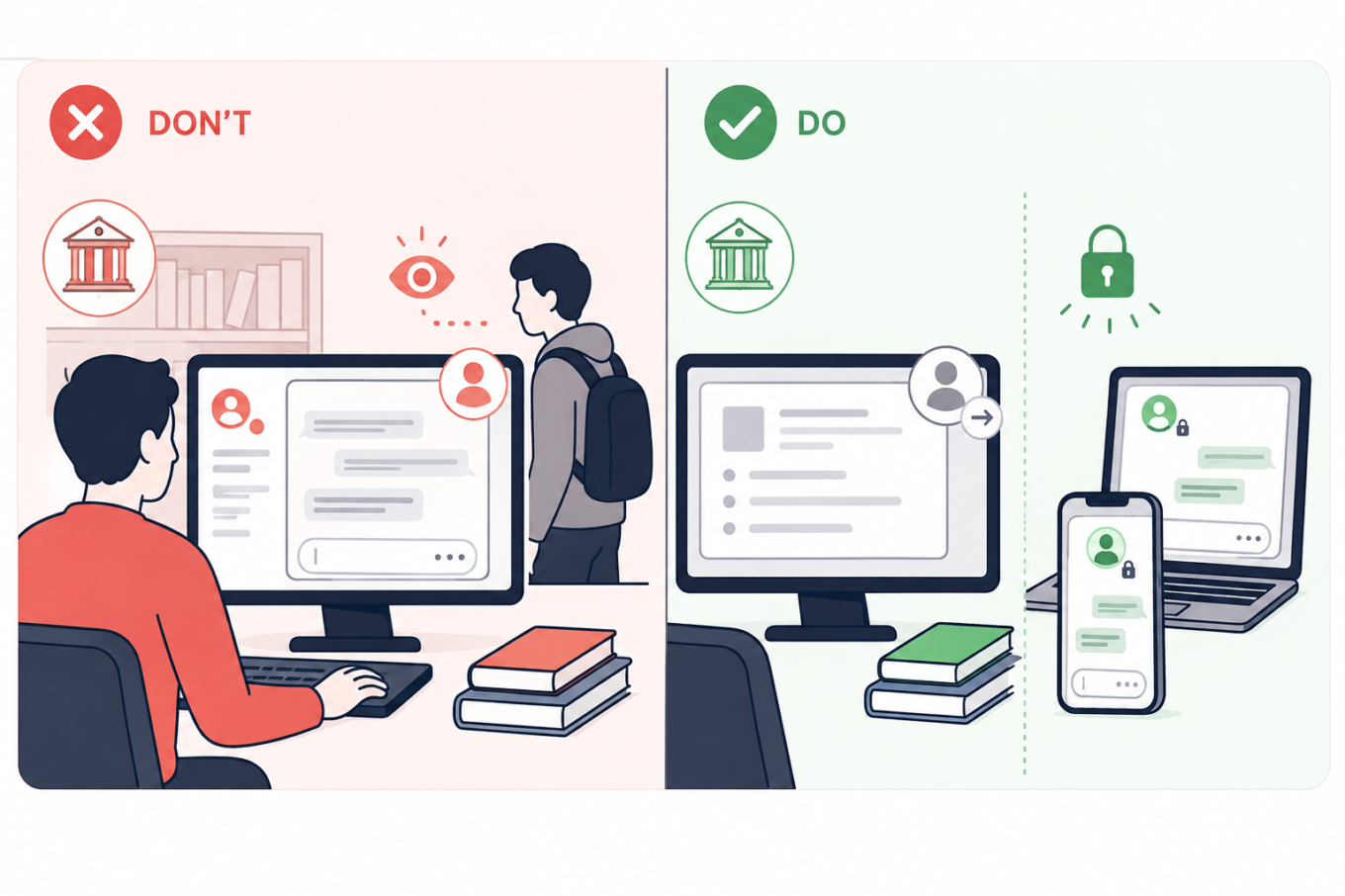
Keep school and shared computers for coursework, and use your own locked devices for personal AI conversations that should not be visible to an institution or another user

6. Turn off model training and use temporary chats for one-off questions

The situation: You use AI to summarize notes, check an assignment, or turn course materials into practice questions.

What are the risks: Depending on the service and settings, your prompts, replies, and uploaded files may remain in your chat history; details may carry into future chats; human reviewers may read some exchanges; and your content may be used to train AI models. Turning off memory does not necessarily stop training or delete past chats. In ChatGPT, regular chats remain in your history even if you turn off model training. Temporary chats are not saved to history and not used for training, but OpenAI may still retain them for up to 30 days, during which they may be reviewed. With regular Claude chats, content allowed for training may remain in de-identified training systems for up to five years, while deleted chats are normally removed from the back end within 30 days. Gemini warns that human reviewers may read some of the data it collects.

What to do: Check the service’s Privacy, Data Controls, Activity, or Model Improvement settings. Turn off optional training and use a temporary or incognito chat when you do not need to keep the conversation. Still, leave sensitive information out: the service has to process anything you send and may keep a copy for some time.
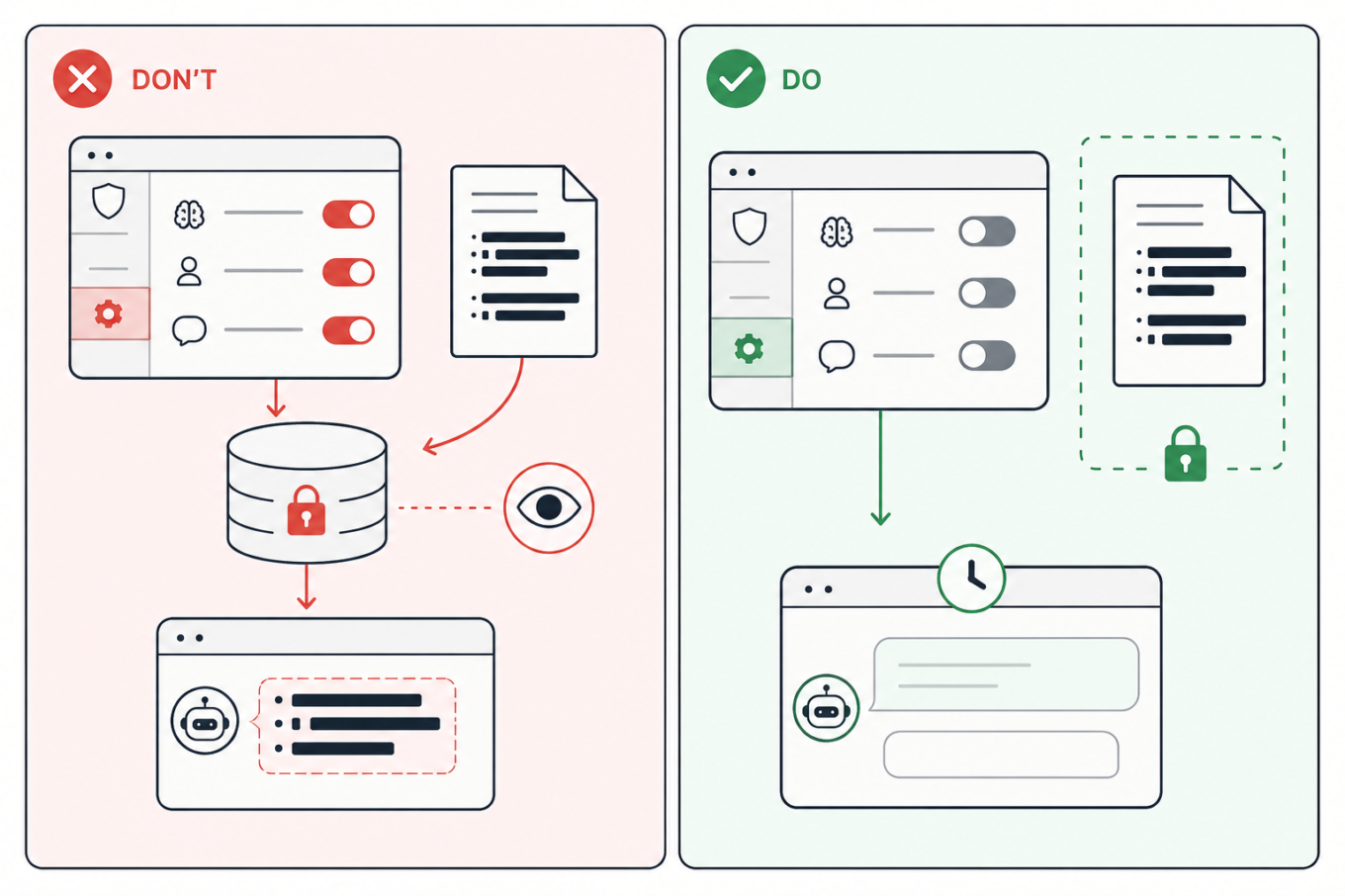
Turn off optional model training and other data-use settings, use a temporary chat when appropriate, and keep sensitive study files out of AI

7. Move the answer to a clean chat before sharing it

The situation: You ask AI to help with an assignment, gradually adding notes, files, and personal context. Once the useful answer is ready, you create a link to send it to a classmate or someone else.

What are the risks: A share link may reveal the whole conversation, not just the answer you meant to send. Anyone who opens it could also see earlier prompts, then forward or save them. Some public links may also appear in search results, either directly or after being posted elsewhere. This has already happened on a large scale: one researcher collected nearly 100,000 publicly shared ChatGPT conversations, while more than 370,000 Grok chats reportedly appeared in search results, some containing personal information, business files, and a password. Public Claude links reportedly exposed health records, internal documents, and children’s contact details too.

What to do: Avoid sharing the original study chat. The safest option is to copy only the answer you need into a separate document and share that. But if you want others to see that it came from AI, ask the same question again in a clean chat, and check the full sharing preview. Open the link in a private browser window to see what others will see. Delete the shared link when it is no longer needed but remember that this cannot erase copies someone has already saved.
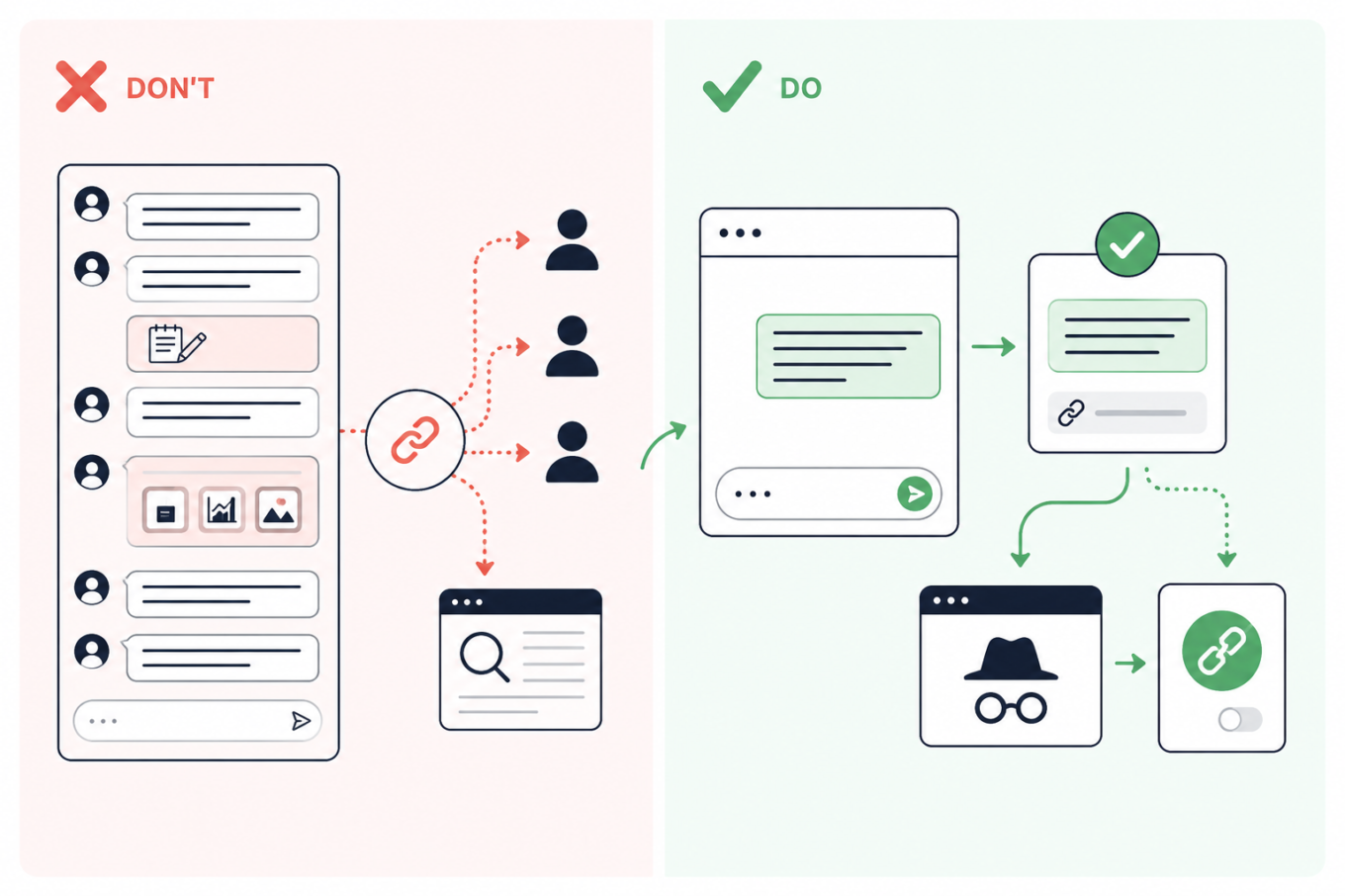
Don’t share a link to a long AI conversation; move the needed answer to a clean chat, preview the link privately, and revoke it after sharing

Likte du dette innlegget?
AdGuard VPN AdGuard DNS AdGuard Mail AdGuard Wallet
Hovedskjermen til AdGuard for Windows
Beskyttelsesskjermen i AdGuard for Windows, som viser beskyttelsesfunksjoner og innstillinger
Statistikkskjermen i AdGuard for Windows, som viser statistikk for blokkerte reklamer og sporere
Appadministrasjonsskjermen til AdGuard for Windows, som viser alternativene for beskyttelsesadministrasjon for apper installert på enheten
20 291 20291 anmeldelser
Utmerket!

AdGuard for Windows: annonseblokkerer for PC

AdGuard for Windows er mer enn en annonseblokkerer. Det er et flerbruksverktøy som blokkerer annonser, kontrollerer tilgang til farlige nettsteder, øker hastigheten på sideinnlasting og beskytter barn mot upassende innhold
Du godtar betingelsene i lisensavtalen når du laster ned programmet
Microsoft Store
Du godtar betingelsene i lisensavtalen når du laster ned programmet
AdGuard for Windows v8.0, 14-dagers prøveperiode
Hovedskjermen til AdGuard for Mac
Stealth-modus-skjermen i AdGuard for Mac
20 291 20291 anmeldelser
Utmerket!

AdGuard for Mac: systemomfattende annonseblokkerer

AdGuard for Mac er en unik annonseblokkerer utviklet med macOS i tankene. I tillegg til å beskytte deg mot irriterende annonser i nettlesere og apper, beskytter den deg mot sporing, phishing og svindel
Du godtar betingelsene i lisensavtalen når du laster ned programmet
Les mer
AdGuard for Mac v2.19, 14-dagers prøveperiode
Hovedskjermen til AdGuard for Android
Sporingsbeskyttelsesskjermen til AdGuard for Android
Appadministrasjonsskjermen til AdGuard for Android, som viser alternativene for beskyttelsesadministrasjon for apper installert på enheten
Statistikkskjermen i AdGuard for Android, som viser statistikk for blokkerte reklamer og sporere
Hovedskjermen til AdGuard sin private nettleser for Android
QR-koden for å laste ned AdGuard for Android
20 291 20291 anmeldelser
Utmerket!

AdGuard for Android: annonseblokkerer for alle apper

Blokkerer annonser og sporere på tvers av alle nettlesere, spill og andre apper. Beskytter personvernet ditt og lar deg kontrollere hvordan appene dine bruker Internett. Installert via APK
Du godtar betingelsene i lisensavtalen når du laster ned programmet
Les mer
Skann for å laste ned
Bruk en hvilken som helst QR-kodeleser som er tilgjengelig på enheten din
AdGuard for Android v4.14, 14-dagers prøveperiode
Hovedskjermen til AdGuard for iOS
Beskyttelsesskjermen i AdGuard for iOS, som viser beskyttelsesfunksjoner og innstillinger
Statistikkskjermen i AdGuard for iOS, som viser statistikk for blokkerte reklamer og sporere
QR-koden for å laste ned AdGuard for iOS
20 291 20291 anmeldelser
Utmerket!

AdGuard for iOS: annonseblokker utover Safari

Den beste iOS-reklameblokkereren for iPhone og iPad. AdGuard fjerner alle typer annonser og sporere i Safari og beskytter personvernet ditt på tvers av alle apper på DNS-nivå

Du godtar betingelsene i lisensavtalen når du laster ned programmet
Les mer
Skann for å laste ned
Bruk en hvilken som helst QR-kodeleser som er tilgjengelig på enheten din
AdGuard for iOS v4.5
Hovedskjermen til AdGuard Content Blocker
Filterskjermen til AdGuard Content Blocker
Innstillingsskjermen til AdGuard Content Blocker
20 291 20291 anmeldelser
Utmerket!

AdGuard Innholdsblokkerer

AdGuard Content Blocker eliminerer alle typer annonser i mobilnettlesere som støtter innholdsblokkeringsteknologi – nemlig Samsung Internet og Yandex Browser. Funksjonene er begrenset sammenlignet med AdGuard for Android, men det er gratis, enkelt å installere og effektivt

Du godtar betingelsene i lisensavtalen når du laster ned programmet
Les mer
AdGuard Innholdsblokkerer v2.8
Hovedskjermen til AdGuard Browser Extension
Sporingsbeskyttelsesskjermen til AdGuard Browser Extension
20 291 20291 anmeldelser
Utmerket!

AdGuard Nettleserutvidelse

AdGuard er den raskeste og letteste annonseblokkeringsutvidelsen som effektivt blokkerer alle typer annonser på alle nettsider! Velg AdGuard for nettleseren du bruker, og få annonsefri, rask og sikker nettsurfing.
Installer
Du godtar betingelsene i lisensavtalen når du laster ned programmet
Installer
Du godtar betingelsene i lisensavtalen når du laster ned programmet
Installer
Du godtar betingelsene i lisensavtalen når du laster ned programmet
Installer
Du godtar betingelsene i lisensavtalen når du laster ned programmet
Installer
Du godtar betingelsene i lisensavtalen når du laster ned programmet
Les mer
Installer
Du godtar betingelsene i lisensavtalen når du laster ned programmet
Les mer
AdGuard Nettleserutvidelse v5.5
Hovedskjermen til AdGuard Assistant
20 291 20291 anmeldelser
Utmerket!

AdGuard Assistent

En ledsagende nettleserutvidelse for AdGuard skrivebordsapper. Den lar deg blokkere egendefinerte elementer på nettsider, legge til nettsider på tillateliste, og sende rapporter direkte fra nettleseren din
AdGuard Assistent v1.4
20 291 20291 anmeldelser
Utmerket!

AdGuard Home

AdGuard Home er en nettverksbasert løsning for blokkering av annonser og sporere. Installer den én gang på ruteren for å dekke alle enhetene på hjemmenettverket ditt – ingen ekstra klientprogramvare kreves. Dette er spesielt viktig for ulike IoT-enheter som ofte utgjør en trussel mot personvernet ditt
AdGuard Home v0.107
Hovedskjermen til AdGuard Pro for iOS
Beskyttelsesskjermen til AdGuard Pro for iOS, som viser beskyttelsesfunksjonene og innstillingene
Statistikkskjermen til AdGuard Pro for iOS, som viser statistikk for blokkerte annonser og sporere
20 291 20291 anmeldelser
Utmerket!

AdGuard Pro for iOS

AdGuard Pro for iOS leveres med alle de avanserte funksjonene for annonseblokkering aktivert. Den tilbyr de samme verktøyene som den betalte versjonen av AdGuard for iOS. Den utmerker seg ved å blokkere annonser i Safari og lar deg tilpasse DNS-innstillinger for å skreddersy beskyttelsen din. Den blokkerer annonser i nettlesere og apper, beskytter barna dine mot upassende innhold og holder dine personlige data trygge.
Du godtar betingelsene i lisensavtalen når du laster ned programmet
Les mer
AdGuard Pro for iOS v4.5
Hovedskjermen til AdGuard Mini for Mac
Safari-beskyttelsesskjermen til AdGuard Mini for Mac
Opprett regel-skjermen til AdGuard Mini for Mac
20 291 20291 anmeldelser
Utmerket!

AdGuard Mini for Mac — Safari annonseblokker

AdGuard Mini for Mac er en kraftig ad-blocker for Safari. Denne lettvektsappen fjerner ads, blokkerer trackere og øker hastigheten på sidelasting. Den hjelper deg med å browse på weben i Safari uten distraksjoner og holde dataene dine private
Installer
Du godtar betingelsene i lisensavtalen når du laster ned programmet
Les mer
AdGuard Mini for Mac v2.3
Hovedskjermen i AdGuard for Android TV med beskyttelse aktivert
Reklameblokkeringsskjermen i AdGuard for Android TV, som viser funksjonene og innstillingene
Innstillingsskjermen i AdGuard for Android TV
Appadministrasjonsskjermen i AdGuard for Android TV, som viser appene der reklamer og sporere er blokkert
20 291 20291 anmeldelser
Utmerket!

AdGuard for Android TV

AdGuard for Android TV er den eneste appen som blokkerer annonser, beskytter ditt personvern, og fungerer som en brannmur for din Smart TV. Få varsler om netttrusler, bruk sikker DNS, og dra nytte av kryptert trafikk. Slapp av og dykk inn i dine favorittprogrammer med topp sikkerhet og null annonser!
AdGuard for Android TV v4.14, 14-dagers prøveperiode
AdGuard-maskoten Agnar som holder Linux-pingvinen
20 291 20291 anmeldelser
Utmerket!

AdGuard for Linux

AdGuard for Linux er verdens første systemvide Linux annonseblokker. Blokker annonser og sporingsverktøy på enhetenivå, velg fra forhåndsinstallerte filtre, eller legg til dine egne — alt gjennom kommandolinjegrensesnittet
AdGuard for Linux v1.4
20 291 20291 anmeldelser
Utmerket!

AdGuard Temp Mail

En gratis midlertidig e-postadressegenerator som holder deg anonym og beskytter personvernet ditt. Ingen spam i hovedinnboksen din!
20 291 20291 anmeldelser
Utmerket!

AdGuard VPN

75 steder i hele verden

Tilgang til alt innhold

Solid kryptering

Ingenting loggføres

Den raskeste forbindelsen

Døgnåpen kundeservice

Prøv gratis
Du godtar betingelsene i lisensavtalen når du laster ned programmet
Les mer
20 291 20291 anmeldelser
Utmerket!

AdGuard DNS

AdGuard-DNS er en alternativ løsning for annonseblokkering, personvernsbeskyttelse og foreldrekontroll. Den er enkel å sette opp og bruke, og gir den nødvendige beskyttelsen mot annonser, nettsporinger og nettfisking, uansett hvilken plattform eller enhet du bruker.
20 291 20291 anmeldelser
Utmerket!

AdGuard Mail

Beskytt identiteten din, unngå spam og hold innboksen din sikker med våre aliaser og midlertidige e-postadresser. Nyt vår gratis tjeneste for videresending av e-post og apper for alle operativsystemer
20 291 20291 anmeldelser
Utmerket!

AdGuard Wallet

En sikker og privat kryptolommebok som gir deg full kontroll over eiendelene dine. Administrer flere lommebøker og oppdag tusenvis av kryptovalutaer å lagre, sende og bytte
Last ned AdGuard For å installere AdGuard, klikk på filen som er angitt av pilen Velg "Åpne" og klikk "OK", og vent deretter på nedlasting av filen. I det åpne vinduet drar du AdGuard-ikonet til "Programmer"-mappen. Takk for at du valgte AdGuard! Velg "Åpne" og klikk "OK", og vent deretter på nedlasting av filen. I det åpne vinduet klikker du på "Installer". Takk for at du valgte AdGuard!
Installer AdGuard på mobilenheten din













































